Be yourself; Everyone else is already taken.
— Oscar Wilde.
This is the first post on my new blog. I’m just getting this new blog going, so stay tuned for more. Subscribe below to get notified when I post new updates.
Be yourself; Everyone else is already taken.
— Oscar Wilde.
This is the first post on my new blog. I’m just getting this new blog going, so stay tuned for more. Subscribe below to get notified when I post new updates.
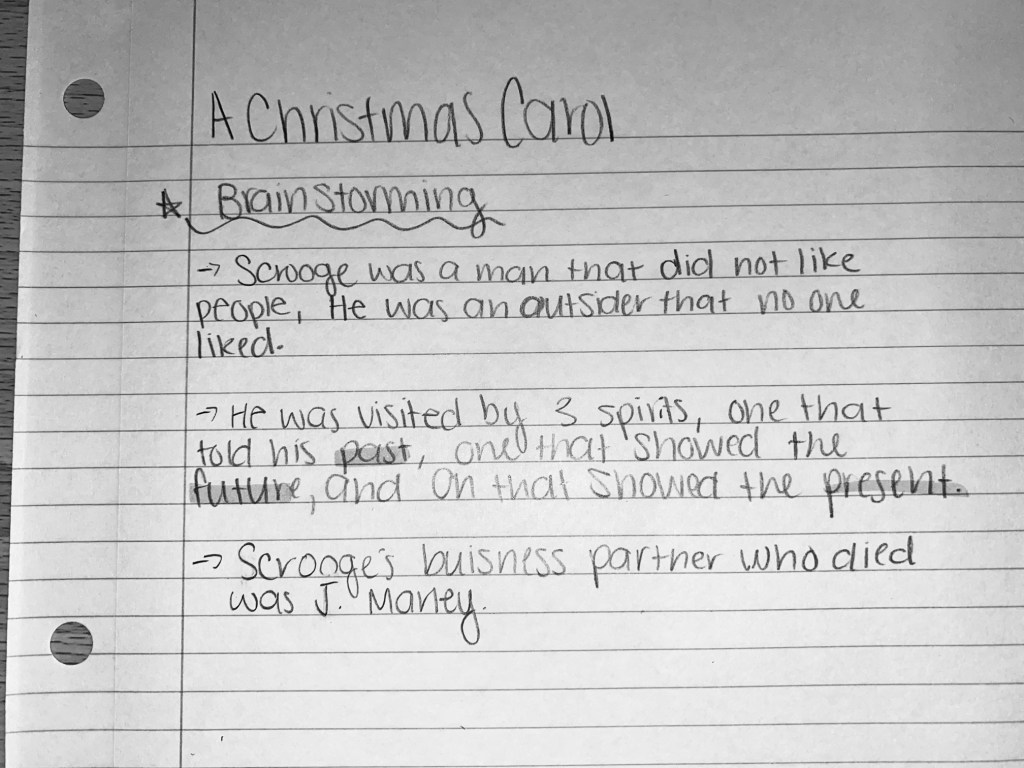
Many people are familiar with Charles Dickens’s novel, “A Christmas Carol.” A tale about a man who hates company and ironically gets visited by three spirits who try to change him from his ways. As stated by Dickens’s novel, Scrooge is a man that, “ No beggars implored him to bestow a trifle, no children asked him what it was o’clock, no man or woman ever once in all his life inquired the way to such and such a place, of Scrooge” (Stave 1.) This quote shows that Scrooge is a man that does not like anyone, he is very selfish. In these series of letters that I wrote portraying to be Scrooge, who is in forced isolation and what he experiences. His experiences show that even being in isolation from everyone and everything takes a toll on those who usually prefer to be away from everyone.
Scrooge’s first letter to his former business partner, Marley.
Marley,
These past few days, I have done nothing but work. I am not complaining, though. I do my work, get paid, and go home to be alone for the rest of the night; a time I quite enjoy actually. Nothing interesting has happened lately, perhaps Mother Nature is brewing up something good for all of us. At this rate, anything can happen and it maybe would provide me with some entertainment. I must go, the fire is dying and I need to go find something to fix for my dinner. I shall write to you again whenever I find the time.
Ebenezar Scrooge – the 1st of March 1843
Scrooge’s Second Letter to Marley.
Marley,
I greatly apologize for my absence and for not writing to you sooner. Things have suddenly taken a crazy turn since I last wrote. Mother Nature, indeed, decided to give us all something to think about. Last Monday, the 13th of March, the town became a complete horror. Businesses are closing and people cannot leave their homes. I fear that my, I mean our, business will close, Oh! Marley, I am certainly dreading these days to come. Once I find more about what is happening, I shall write back.
Ebenezer Scrooge – 20th of March 1843
Scrooge’s Third Letter to Marley.
Marley,
Oh! Marley! The strangest occurrence has just happened to me! I am still continuing to work, despite one’s better judgment – I am not ready for my life to suddenly change. As I had gotten home from work a few days ago, things were rather chaotic. People cannot afford to be out of work, and despite the orders for everyone to stay home, there seems to be more of an abundance of people out on the streets. Marley, it is a true sight to see, indeed. I entered my house to continue on with my evening. Around 8 o’clock or so, I saw a mysterious white light that seemed to bounce around my room. I blew it off because I was certain it was from the streets below. I sleepily close my eyes and seem to sleep for an hour, if not a little more or less. Marley, I am not lying when I say this light is indeed a person. The light-man, as I have decided to call him, has seemed to take me back to life before this pandemic. Apparently, Cholera, the intestinal disease has returned and it has certainly wreaked havoc. The light-man showed me things that I have done in the past, rather odd. It is like he is trying to make me feel like I miss being around people, which I do not. I hate that my normal life was abruptly changed because of the return of the disease that was supposed to have ended 7 years ago. I feel that I will have more time to write to you. Who knows, maybe the light-man will return and tell me more about things that have happened or that may come.
Ebenezar Scrooge – 1st of April 1843
Scrooge’s Fourth Letter to Marley.
Marley,
First and foremost, I want to apologize for the long time that has passed since you heard from me. In my last letter, I mentioned a light-man who visited me and showed me the past. Well, Marley, it happened not once, but twice more. A few short days after the first experience, I was greeted this time by a large man who seemed to be Mother Nature. He showed me things that were happening at the present time. Marley, I saw things I hope I never see again. I saw poor people dying and those that had to go without. It really opened my eyes. These people do not deserve this. I have not been to work in weeks, I just sit here and wait for the spirits to visit me and write you letters that I know you do not receive. This is all falling apart and I cannot alone fix it. After seeing what was happening in the present time, I was not sure I wanted to see what the future holds. However, to my dismay, a blacked cloaked figure entered my room late one night. Marley, he was the scariest spirit that has visited me. I could not see his face, I am not sure he even had a face. He showed me the future and he showed me how this disease from this pandemic would take my life if I did not change my ways and soften my heart to love people. I knew right then I had to change and I did. After I finish this letter, I am going out to help those in need. God bless you, Marley. I will write again very soon!
Ebenezar Scrooge – 25th of April 1843
Works Cited
Ambardekar, Nayana. “Cholera: Causes, Symptoms, Treatment, and Prevention.” WebMD,
WebMD, 27 July 2019, Date Accessed 29 April 2020
www.webmd.com/a-to-z-guides/cholera-faq.
Dickens, Charles. “A CHRISTMAS CAROL.” A Christmas Carol, by Charles Dickens, The
Project Gutenberg Literary Archive Foundation, 1865, Date Accessed 29 April 2020
www.gutenberg.org/files/46/46-h/46-h.htm#link1.
In Mary Shelley’s novel, “Frankenstein”, Shelley uses numerous other literary works to form and bring support to her fiction story. One of the works that Shelley includes in Frankenstein is Samuel L. Coleridge’s, “The Rime of the Ancient Mariner”. This literary work is used rather frequently when comparing her novel’s characters to those in the poem. Shelley incorporates this work by comparing Victor Frankenstein, the main character of Frankenstein, Frankenstein’s monster, and Robert Walton, the character mentioned several times in the preface. Both Shelley’s characters can be compared to the Mariner that killed the albatross and how in each of their lives, they lived out like this poem.
Throughout Shelley’s novel, “Frankenstein”, Shelley draws connections with Coleridge’s, “Rime of the Ancient Mariner”. Small glimpses of these connections can first be seen in the Preface of Frankenstein (pgs. 11-26), which consists of letters between Robert Walton and his sister, Mrs. Saville of England. Out of all four letters that Walton writes to his sister, he mentions Coleridge’s poem in his second letter. Within this letter, Walton tells his sister all about his uneventful journey he is currently on and where he is planning on going. In the sixth paragraph, Walton writes, “I am going to unexplored regions, to “the land of ice and snow;” but I shall kill no albatross, therefore do not be alarmed for my safety, or if I should come back as you as worn and woeful as the “Ancient Mariner?” (page 18). In Coleridge’s poem, the sailors are heading to a land that is barren of any form of land, nothing but ice. The similarity in this is that both the Mariner and Walton are both sailors that seem to be heading towards the same place, but Walton will not be dumb enough to endanger himself. Shelley most likely brings up this reference in Walton’s letters to present the idea that Walton is extremely similar to the Mariner in these letters. Also, Walton who serves as the audience mentioned in the poem who hears the Mariner’s story. Shelley also compares Coleridge’s poem to Victor Frankenstein and the monster he creates.
Mary Shelley’s novel, Frankenstein, is about a student named Victor Frankenstein who is mesmerized by the ideas of natural philosophy, and its wondrous laws. One night in November, Frankenstein brings to life the monster that will, in many ways, haunt his life forever. Throughout this novel, Shelley references Coleridge’s poem, “Rime of the Ancient Mariner”. For example, in the Preface, Walton talks about meeting a stranger and how odd the stranger seems. The stranger tells Walton, “…to seek the one who fled from me” (pg. 22). Although Coleridge’s poem is not directly referenced here, one can draw a parallel. In this case, the stranger is looking for the person that fled away from him. This stranger symbolizes the Mariner, always going around to tell his tale. Regardless of how it sounds, he must tell it since it is his to tell. Not only does the stranger relate to the Mariner, but the creator himself, Victor Frankenstein. Victor relates to the Mariner because after creating this monster, he seems to want to hide what he has done. For example, a stanza from Coleridge’s poem is referenced on page 53. This stanza says, “Like one who, on a lonely road, Doth walk in fear and dread, And, having once turned around, walks on, And turns no more his head; Because he knows he knows a frightful fiend Doth close behind him tread”. When the Mariner killed the albatross, it followed him everywhere, knowing that he could not unlive the story. He must accept that it is his story. This is similar to Victor Frankenstein because even though he is proud of his creation, he feels guilty for it and because it’s done, he cannot escape the reality of it. He must live with it and go on. Both Victor Frankenstein and his monster both relate hand-in-hand to Coleridge’s Mariner.
To conclude, Shelley knows how to use literary works to create parallels between her characters and those in other works. Throughout her novel, “Frankenstein”, Shelley uses Coleridge’s poem to form parallels between three of the main characters. For example, Robert Walton who represents the audience of the Mariner’s story, Victor Frankenstein as the Mariner who needs to face his reality and not run from it, and lastly, the monster created by Frankenstein who represents the Mariner who must live to tell those of this tale. Overall, these parallels go hand in hand with each other.
Works Cited
Coleridge, Samuel Taylor. “The Rime of the Ancient Mariner.” The Norton Anthology of
British Literature: The Romantic Period. 10th ed. Stephen Greenblatt, General Editor.
W. W. Norton, 2017. pp. 448-64.
Shelley, Mary. Frankenstein. Preface, pages 11-12, Barnes and Noble, 2003.

One glance at this artwork called The Nightmare and one can notice several things going on. For example, the ghostly horse in the right corner, or the stalkerish demon looking over the sleeping woman in white. What did the painter, Henry Fuseli want the demon and the horse symbolize and why are they creepily watching over this woman? One could potentially say that the demon and the horse symbolize the weights of the woman’s life that are causing her nightmares.
This particular painting could depict a fairly decent portrait of Mary Shelley–the true author of Frankenstein. For example, the demon and horse could represent the struggles she faced as a woman. Shelley had lost nearly every person around her, such as friends, babies, her husband, her sister and some others (xiv). From this beginning, anyone can see the toll this would take on a person. Therefore the horse could be representing all those around her that she lost and how it was a burden to her. No loss was as significant as the death of her mother. The demon could be representing the burden of not having a mother and having half a family. For example, Shelley was always craving the attention from her father because her mother had died giving birth to her (xiii) and as she noted it in Frankenstein, “… and ultimately it is responsible for the death of the one that gave it life” (xxvi). That was an apparent burden Shelley carried around her whole life of being, what she thought, the one responsible for her mother dying. Because she lost all those around her, she formed it into writing. She put her burdens to good use.
Fuseli, Henry. The Nightmare. “The Norton Anthology of British Literature: The Romantic Period.“ 10th. Stephen Greenblatt and W. W. Norton, 2018. p. C5.
Shelley, Mary. “Frankenstein”. Introduction by Karen Karbiener. Barnes and Noble, 2005. p. xiii-xxvi.
This is an example post, originally published as part of Blogging University. Enroll in one of our ten programs, and start your blog right.
You’re going to publish a post today. Don’t worry about how your blog looks. Don’t worry if you haven’t given it a name yet, or you’re feeling overwhelmed. Just click the “New Post” button, and tell us why you’re here.
Why do this?
The post can be short or long, a personal intro to your life or a bloggy mission statement, a manifesto for the future or a simple outline of your the types of things you hope to publish.
To help you get started, here are a few questions:
You’re not locked into any of this; one of the wonderful things about blogs is how they constantly evolve as we learn, grow, and interact with one another — but it’s good to know where and why you started, and articulating your goals may just give you a few other post ideas.
Can’t think how to get started? Just write the first thing that pops into your head. Anne Lamott, author of a book on writing we love, says that you need to give yourself permission to write a “crappy first draft”. Anne makes a great point — just start writing, and worry about editing it later.
When you’re ready to publish, give your post three to five tags that describe your blog’s focus — writing, photography, fiction, parenting, food, cars, movies, sports, whatever. These tags will help others who care about your topics find you in the Reader. Make sure one of the tags is “zerotohero,” so other new bloggers can find you, too.
Have a WordPress.com account? Log in now.


